Is It Just Me? Why the 2026 Houston Budget Math Is Broken
Let us be real: The Houston math just ain’t mathin'.
FINANCIAL WELLNESS (LIFESTYLE)RESOURCE ALLOCATIONFIXED EXPENSES (STAPLES)TAX STRATEGY & UPDATES
Nyeva
3/19/20266 min read
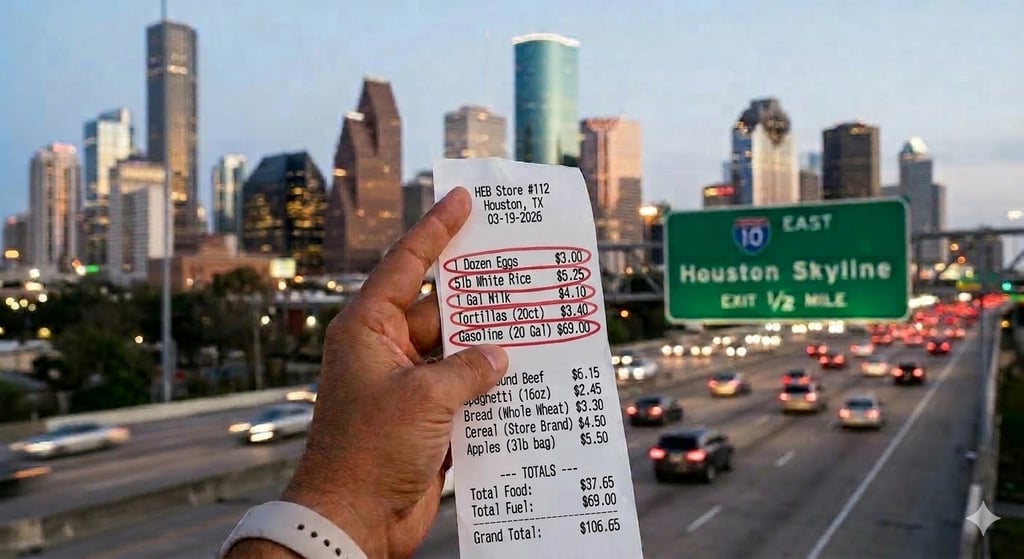
You are working the same hours. You might have even landed a small raise. But when you look at your banking app after a standard run to HEB or paying the CenterPoint bill, the numbers do not add up. You started the month with $5,000 in take-home pay, but by the 15th, it feels like you only ever had $3,500.
You aren't crazy, and you aren't necessarily bad with money. You are just living through the 2026 Houston Squeeze. While the median Houston household income has edged up to approximately $67,500 annually [1], the purchasing power of that check has been eroded by local and global forces. As your Household CFO, I am stepping into the messy middle of your bank statement to show you exactly where the math broke...and how we are going to fix it.
A Note for My Non-Houston Neighbors
While I am using Houston as our case study today (because let’s be real, the Bayou City squeeze is hitting us hard) if you are reading this from Austin, Atlanta, Tacoma, or anywhere in between, this math is for you too. Whether you are shopping at HEB, Publix, or Kroger, the wallet hit is a universal reality. The local numbers might change, but the strategy to reclaim your breathing room remains exactly the same.
The Reality Check: Why Everything Costs More
To understand your bank account, we have to understand the world around us. For a Houstonian, 2026 inflation is driven by three specific, local levers.
1. The Logistics Lag and the Port of Houston
Houston is the number one port in the U.S. by total waterborne tonnage [2]. However, the cost of moving a shipping container from the terminal to a local distribution center has spiked. Rising diesel costs, which reached approximately $4.50 per gallon in early 2026 [3], mean that the last mile of delivery– the part where the food gets to your neighborhood store– is more expensive than ever. Retailers are passing these transportation surcharges directly to you at the checkout counter.
2. The 2026 Pantry Pillar Tariffs
Specifically affecting our dry goods like spaghetti and rice, new trade policies in early 2026 have placed higher duties on various imported goods [4]. Since many premium and store-brand staples rely on global supply chains, these previously cheap fillers have seen significant price jumps in Houston zip codes.
3. The Texas Energy Transition
While we are the energy capital of the world, our local utility grid is undergoing a massive modernization. Following state approval of a $2.9 billion resiliency plan [5], CenterPoint Energy has implemented new fees to harden the grid against Gulf storms (which, to be fair, seem to be showing bigger and more often). This sets a new, higher floor for your monthly fixed costs.
The Deep Dive: 2024 Staples vs. 2026 Reality
To find your Breathing Room, we have to identify the leaks. Let us look at the real math of your weekly staples.
Note on the Median Household: When we discuss these figures, we are looking at the average Houston household size of 2.8 people [1]. This typically represents a family of three (two adults and one child) trying to balance a single or dual income against these rising costs.
Real Math: The Kitchen Table Audit
In 2024, staples were the predictable part of the budget. In 2026, they are the most volatile.
The CFO Takeaway: If your pantry pillars increase by 50-96%, the traditional advice to just eat cheap stops working. You cannot frugal your way out of a doubling of base food costs. You have to find a raise in your existing cash flow.
Sources and Footnotes
U.S. Census Bureau: Houston City Profile: Median Income and Household Size. Data reflects the median household size of 2.8 and updated 2026 income projections.
Port Houston Authority: 2025-2026 Tonnage and Container Records. Confirms Houston’s status as the #1 port for waterborne tonnage.
FRED / St. Louis Fed: PADD III Gulf Coast Weekly Retail Diesel Prices. Tracks the March 2026 surge toward the $4.80+ range.
U.S. Department of Commerce: 2026 Trade Policy and Tariff Schedules. Analysis of new duties on imported base-level dry goods and pasta.
Energy Capital HTX: CenterPoint $2.9B Grid Resiliency Approval. Details on the PUC approval and the subsequent monthly rate increases for 2026-2028.
USDA Economic Research Service: Food Price Outlook: Summary Findings 2026. Forecasts for 5.5% increases in beef and the volatility of pantry staples.
TomTom Traffic Index: Houston Congestion and Commute Statistics. Data on average daily commute times and distances for the Houston metro area.
AAA Gas Prices: Texas State Average Fuel Tracker. Real-time data showing the March 2026 jump to $3.58 for regular and $4.80 for diesel.
Texas Comptroller: The Impact of Rising Home Insurance Premiums. Analysis of how storm frequency and inflation have decoupled Texas premiums from national averages.
The Final Word: You Aren’t Failing, the System Just Shifted
If you’ve spent the last few months feeling like you’re running on a treadmill that keeps getting faster, I want you to hear this: It’s not just you. The 2026 Houston Squeeze is a real, measurable phenomenon. Between the grid resiliency fees, the port logistics, and the price of a gallon of milk, the baseline for a comfortable life in the Bayou City has moved. But while we can’t control the global supply chain or the Texas power grid, we can control how we respond to them.
Being the Household CFO isn't about deprivation or never buying another $9 smoothie. It’s about intentionality. It’s about looking at that $1,500 gap and saying, I see you, and I’m taking my power back. By auditing your staples, killing high-interest leaks, and visualizing your trade-offs, you’re doing more than just budgeting. You’re building a wall of protection around your family’s future. The math might be broken right now, but with the right strategy, your peace of mind doesn't have to be.
Let’s stop the guessing and start the growing.
Ready to see exactly where your money is going?
🔗 Download the Breathing Room Calculator here and let’s get your math back on track.
Real Math: The Commute Tax
(The I-10 and 610 Reality)
Houstonians drive an average of 30 miles per day round-trip [7]. In 2026, the Commute Tax is a major drain on household wealth.
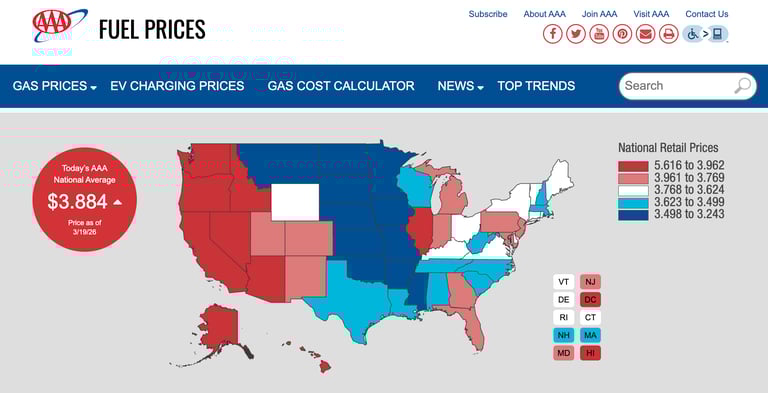
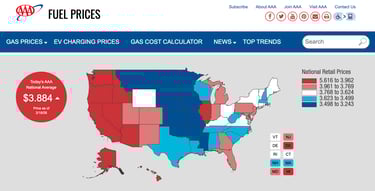
The Fuel Factor: According to AAA, the average price for regular gas in Texas has climbed to $3.58 per gallon [8].
The Squeeze: For a standard SUV with a 20-gallon tank, you are paying $12.00 more per fill-up than in 2024.
The Annual Hit: This equates to $1,248 a year diverted from your savings into your gas tank.
Real Math: The Texas Ceiling (Electricity & Insurance)
This is the most aggressive invisible leak. It is the price of simply existing in a home in Harris, Fort Bend, or Montgomery County.
Insurance Surge: Texas homeowners insurance premiums have decoupled from national averages due to increased storm frequency and labor costs [9].
Grid Fees: The approved CenterPoint resiliency plan adds a monthly rate increase that scales up as infrastructure projects go live [5].
The Would You Rather of 2026: Visualizing Your Leaks
At The Vera Math, we use trade-offs to bring clarity. To understand why your $5,000 monthly take-home income feels like $3,500, look at what your wants actually cost in staples.
The Streaming Habit: That $18.99 monthly sub represents 77 gallons of gas a year. You are trading a road trip for a Netflix login.
The Smoothie Habit: A $9.00 weekly smoothie represents 114 Gallons of Milk or 190 packs of Spaghetti. That is nearly 200 family dinners traded for a drink.
The Wardrobe Update: A $60.00 pair of shoes is 11 Bags of Rice. That is enough rice to provide a side dish for every dinner for three months.
The Step-by-Step Household CFO Audit
Ready to stop the bleeding? Follow this 3-step audit to find your Breathing Room.
Step 1: Identify the Digital Ghosts
Look at your statement for any recurring charge under $20. Cancel three ghosts, and you have just offset the inflation on your groceries for the entire month.
Step 2: Target the APR, Not the Balance
Do not put a lump sum toward a 4% car loan while carrying a 29% store card. Erasing the higher-interest store card payment is a guaranteed monthly raise.
Step 3: Use the Breathing Room Calculator
You cannot manage what you do not measure. Our calculator allows you to plug in these 2026 Houston prices and see exactly where your gap is.
Contact
Feedback, inquiries: hello@theveramath.com
© 2026 The Vera Math. All rights reserved.

Privacy Policy & Terms
Financial Disclaimer: The content on The Vera Math is for informational and educational purposes only and does not constitute professional financial, tax, or legal advice. I am a Household CFO sharing personal experience and math-based insights; please consult with a licensed professional before making significant financial decisions.