The Sunk Cost of Clutter
Why Your “Expensive” Mistakes are Costing You More to Keep Than to Toss
HOUSEHOLD MANAGEMENTRESOURCE ALLOCATION
Nyeva
2/28/20264 min read
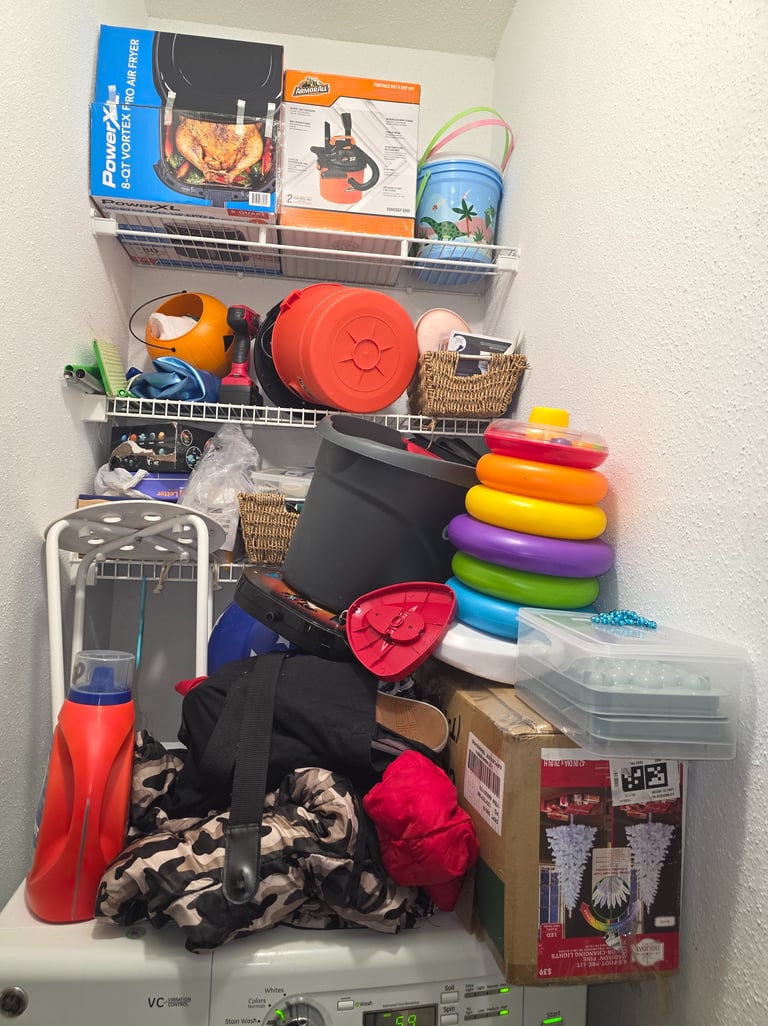
My actual laundry closet (eeek).
We’ve all stood in front of a closet or a storage nook, staring at a purchase that makes our stomach sink. Maybe it’s a $150 dress with the tags still on, an $80 kitchen gadget used exactly once, or a $40 “bargain” top that somehow never fit quite right. You want to get rid of it to clear the space, but a voice in your head stops you: “I can’t throw that away. It was expensive.”
In the world of Vera Math, this is a classic financial trap. You are treating your home like a high-priced storage unit for your past mistakes. The money you spent is gone– it’s a "sunk cost." The only question remaining is how much more of your life, space, and mental peace you are willing to pay to keep it there.
Section 1: Defining the Sunk Cost Fallacy
To understand why we cling to clutter, we have to look at behavioral economics. A Sunk Cost is money that has already been spent and cannot be recovered. The Sunk Cost Fallacy is our human tendency to continue an endeavor or keep an item simply because we’ve already invested resources in it, even when the current costs outweigh any future benefit.
Imagine a CFO at a major corporation. If a project is failing and hemorrhaging cash, a competent CFO doesn't say, “Well, we’ve already spent $5 million, so we have to keep spending more to make it worth it.” No, they cut their losses. They stop throwing “good money after bad.”
In your home, "good money" is your Square Footage and your Mental Peace. By keeping an item you don't use, you are actively "paying" for that item every single day.
Section 2: The Real Estate Math (A Houston Case Study)
Your home is likely your largest financial asset, and every square foot has a price tag. When you allow unused items to occupy space, you are essentially paying "rent" on their behalf.
To run this calculation for your own home, you first need to know your total square footage:
For Renters: Check your lease or floor plan.
For Homeowners: Look at your closing docs or if you're in Houston like I am, your latest Harris County Appraisal District (HCAD) statement.
The Benchmark: For context, a typical 2-bedroom apartment in Houston averages ~1,050 sq. ft.
The Audit
Let’s look at a real-life example of a catch-all nook in my laundry room. This space serves as a "landing zone" for items that need a decision: to-donate bags, old boxes, and items I'm not quite ready to deal with.
Calculate Your Real Estate Cost: Divide your Monthly Rent/Mortgage by your total Square Feet.
Example: If your rent/mortgage is $2,100 for a 1,050 sq. ft. home, your cost is exactly $2.00 per sq. ft.
Measure the Clutter Footprint: This laundry nook is roughly 4 feet wide by 2 feet deep– 8 square feet.
The Vera Math: Multiply your cost per sq. ft. by that footprint.
If this nook stays full for five years, I have effectively paid nearly $1,000 for the privilege of storing items that provide zero utility.
Section 3: The Maintenance Tax and Cognitive Load
Beyond the literal rent, there is the Maintenance Tax. Every item you own requires management energy. You have to move it to vacuum, organize it as it shifts, and process the guilt every time you see it.
If we estimate that every unused item takes just 2 minutes of your time per year to manage, and you have 100 such items, you are spending over 3 hours of labor annually on dead capital. Using your Take-Home Wage (which you can calculate on our Life Ledger page), you can see exactly how many dollars of your labor are being siphoned away by stuff you don't even like.
Section 4: Moving from "Loss" to "Liquidated Asset"
So, how does a Household CFO handle these "Sunk Costs"? We pivot.
1. The "Write-Off" Strategy
In business, taking a tax loss frees up capital for better investments. In your home, donating an item is your write-off. The "dividend" you receive is immediate: space, peace, and the end of the Maintenance Tax.
2. The Resale ROI Audit
Many people hold onto clutter because they plan to "sell it to make the money back." But a smart CFO accounts for the Cost of Labor.
The Negative ROI Trap: If it takes 2 hours to photograph, list, and ship a $20 item and your Take-Home Wage is $30/hour, you are losing $40 of your life's value to chase a $20 return. That is a net loss.
The High-Value Pivot: However, if the item’s resale value is significantly higher than your hourly labor rate, reselling becomes a legitimate Liquidated Asset.
The CFO’s Efficient Resale Protocol
If you decide to sell, do not let the item sit in "resale limbo" for months. Set strict protocols to ensure your home doesn't become a warehouse:
The 72-Hour Listing Rule: If it isn't photographed and listed within 72 hours of entering the "To-Sell" bin, it gets donated. No exceptions.
The "Batching" Method: Never go to the post office for one $15 shirt. Group your sales so you are making one trip for $100+ in recovery.
The 30-Day Markdown: If an item hasn't sold in 30 days, slash the price by 50% or donate it immediately to stop the "Maintenance Tax" from accruing.
Conclusion: The Net Worth of Your Peace
The sticker price you see at the register is a vanity metric. What truly matters to your bottom line is how an item serves your future, not how much it commemorates a past spending error.
When you clear the sunk costs from your laundry nook, your closet, and your mind, you increase the Net Value of your daily life. Your home should be an asset that supports your goals, not a warehouse for your regrets.
Ready to run your own audit? Head over to the Life Ledger to calculate your true Take-Home Wage and use our Clothing ROI Calculator to see which items in your closet are actually "working" for you.
Contact
Feedback, inquiries: hello@theveramath.com
© 2026 The Vera Math. All rights reserved.
Privacy Policy & Terms
Financial Disclaimer: The content on The Vera Math is for informational and educational purposes only and does not constitute professional financial, tax, or legal advice. I am a Household CFO sharing personal experience and math-based insights; please consult with a licensed professional before making significant financial decisions.