The Setup vs. The Scramble
Why 10 Minutes at Night Buys a Better Morning
HOUSEHOLD MANAGEMENTRESOURCE ALLOCATION
Nyeva
2/21/20265 min read


We’ve all been there. It’s 7:15 AM. You’re hunting for a matching sock, preparing school lunches, realizing the field trip form isn't signed, and the coffee pot is empty. You’re navigating a minefield of half-eaten cereal and "where is my backpack?" screams. By the time you get the kids to school and yourself to work, you haven’t just lost time...you’ve lost your peace. You’ve already used up a day’s worth of emotional energy before your first meeting.
In the world of The Vera Math, we don't just audit dollars. We audit Human Capital.
Human capital is your energy, your focus, and your patience. It is a finite resource. When you start your day in a "scramble," you are essentially burning through your most valuable assets at an unsustainable rate. To win your day, you have to stop the Scramble and start the Setup.
The Science of the Scramble: Why It’s Costing You More Than Time
Most people think "it only takes a minute" to find a pair of shoes or pack a lunch. But real math tells a different story. When we are in a scramble, we aren't just moving fast; we are paying three specific hidden taxes that compound throughout the day.
1. The Switching Cost Tax
Every time your brain is forced to pivot, from helping a child with a zipper to remembering if there’s ham in the fridge for a lunch, you pay a cognitive fee.
Psychologists call these "Switching Costs." According to research on Switching Costs, every time you pivot from signing a permission slip back to packing a lunchbox, you pay a cognitive fee. Studies show this mental jumping can eat up to 40% of your productive time. Your brain has to re-load the rules for each new task, making every 1-minute job take significantly longer. In a morning scramble, you aren't multitasking; you’re just failing at three things simultaneously at a 40% premium.
2. The Decision Fatigue Leak
Your brain is like a battery. Every decision you make– from "What should they wear?" to "Which route has less traffic?"– drains that battery. Combine that with the Planning Fallacy– our biological tendency to underestimate how long simple tasks take- and it’s easy to see why 'just five minutes' of searching for shoes turns into a twenty-minute catastrophe. By the time you get out the door, you’ve already hit Decision Fatigue, draining the mental energy you need for the rest of your day.
When you spend your peak brain power on low-value decisions at 6:45 AM, you have less capital left for the high-value decisions you need to make at work or for your family later that evening. A CFO would never spend 50% of the company’s budget on paperclips; so why spend 50% of your mental energy on matching socks?
3. The Planning Fallacy & The Cortisol Spike
Nobel Prize winner Daniel Kahneman identified the "Planning Fallacy," which explains our biological drive to underestimate how long a task will take. As noted in The Decision Lab, we "tend to create overly optimistic timelines and budgets"..."because we focus too much on the best-case scenario and ignore relevant historical data or potential setbacks."
When we realize we’re late, our body releases cortisol. While cortisol is great for running from a predator, it’s terrible for logistics. It impairs your prefrontal cortex: the part of the brain that handles planning and math. This is why you can’t find your keys even when they are sitting right in front of you. You are literally "too stressed to see."
The "Sunk Cost" of a Bad Morning
In business, a "sunk cost" is an investment that has already been made and cannot be recovered. A stressful morning is a sunk cost that ripples through your entire day.
If you arrive at work frazzled, it takes you 30 to 45 minutes just to settle before you can be productive. If you come home after a long day to a house that was left in a scramble state (unmade beds, dirty breakfast dishes), your rest period is immediately interrupted by a cleanup period.
You are effectively paying interest on the chaos of the morning all the way until you go to sleep.
The CFO Strategy: The 10-Minute "Evening Infrastructure" Audit
We don't need a total life overhaul. We need better systems. A Household CFO looks for "High-ROI" habits– small investments that pay out massive dividends. Here is your 3-step "Setup" plan:
1. The "Launchpad" System (Physical Logistics)
Every corporate headquarters has a loading dock. Your home needs one, too.
The Move: Designate a single "launchpad" near the door. Everything required for the departure (the morning exit) must be on that pad by 9:00 PM.
The Audit: Keys, backpacks, signed forms, work ID, and umbrellas. If it isn't on the pad, it doesn't exist.
The Math: If searching for these items takes 5 minutes in a scramble, but placing them there takes 30 seconds in a setup, you are gaining a 1,200% return on your time.
2. The "Pre-Flight" Check (Info. Audit)
The Move: Spend 2 minutes checking the "environmental data." Check the weather and the school/work calendar.
The Logic: Finding out it’s pajama day at 7:05 AM is a crisis. Finding out at 8:30 PM is a 2-minute task.
The CFO Tip: Use this time to "close the books" on the day. Check your bank app, glance at your calendar for tomorrow, and clear your mental tabs.
3. The "Uniform" Principle (Removing Decision Fatigue)
The Move: Pick the outfits (yours and the kids') and pack the lunches tonight.
The Math: You are pre-funding your morning's mental energy. By making these low-stakes decisions now, you are saving your high-stakes brainpower for the things that actually move the needle in your life.
Real Math for Real Life: The Time Dividend
Let's look at the Quarterly Audit of your life if you commit to the Setup:
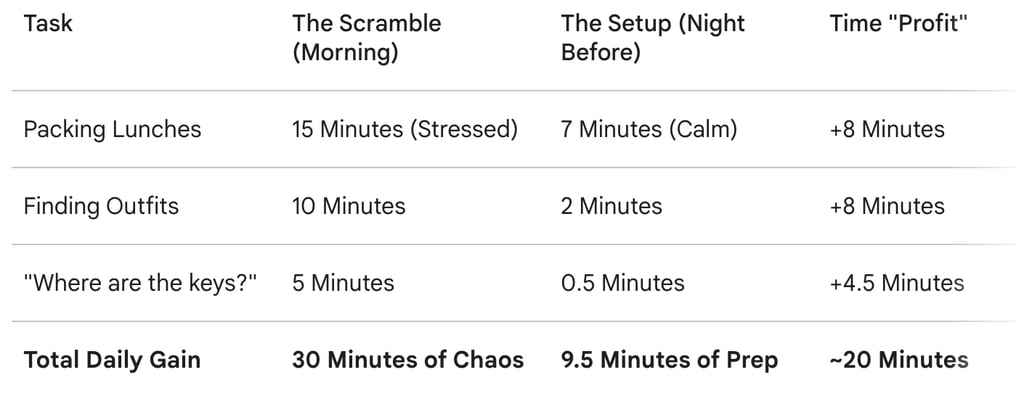
20 minutes a day = 121 hours a year.
Imagine what you could do with an extra 121 hours. That’s enough time to:
Start a side business.
Exercise for 30 minutes, 4 times a week, for an entire year.
Read 15-20 books.
Or, most importantly, just sit and breathe.
The First Action Step: The 1-Item Rule
The mistake most people make is trying to fix everything at once. That just creates more friction.
Tonight, I want you to pick just ONE item. Maybe it’s the shoes. Maybe it’s the coffee prep. Maybe it’s signing the permission slips. Commit to moving that one item from the "Morning Scramble" to the "Evening Setup."
You’ll wake up tomorrow with a small "time dividend." Don't spend that extra time rushing. Use it to realize that you are the CFO of this house, and you just made your first profitable trade of the day.
Join the Inner Circle
Ready to audit the rest of your life? Join our Substack to get the Executive Summary– a periodic briefing on the "Vera Math" systems you need to protect your household’s bottom line and your own sanity.
External links for more information on this topic:
Contact
Feedback, inquiries: hello@theveramath.com
© 2026 The Vera Math. All rights reserved.

Privacy Policy & Terms
Financial Disclaimer: The content on The Vera Math is for informational and educational purposes only and does not constitute professional financial, tax, or legal advice. I am a Household CFO sharing personal experience and math-based insights; please consult with a licensed professional before making significant financial decisions.