The Vera Math Methodology: How We Anchor the Life Ledger in 2026 Economic Data
Discover the math behind the Life Ledger. We translate dollars into the 'Hours of Life' required to earn them, helping you calculate the true cost of any purchase.
HOUSEHOLD MANAGEMENT
Nyeva
2/12/20262 min read
At The Vera Math, we believe that a household budget is only as strong as the data behind it. As we navigate the economic landscape of 2026, the "guesswork" of traditional budgeting is no longer sufficient for a Household CFO. To ensure our tools like the Life Ledger and Fit Logic provide actionable insights, we utilize a rigorous data-sourcing methodology anchored in national benchmarks.
1. Real-Time Data Integration
Our calculators do not operate in a vacuum. To provide accurate "Strategic Spending" results, we baseline our logic against three primary government and industry data sets:
Consumer Price Index (CPI): We monitor monthly releases om the U.S. Bureau of Labor Statistics (BLS). By tracking the "Food at Home" and "Energy" indices, we ensure our spending baselines reflect the actual purchasing power of the dollar in 2026.
USDA Food Plans: We utilize the USDA’s Thrifty, Low-Cost, and Liberal Food Plans to define what an "efficient" grocery spend looks like for various family sizes.
EIA Energy Outlook: Residential electricity and natural gas rates are calculated using the U.S. Energy Information Administration (EIA) weekly retail averages.
2. The Life Ledger: Measuring the "Life Energy" Exchange
The core innovation of The Vera Math is moving beyond traditional bookkeeping to measure the Life Energy cost of a purchase. Most people view a $100 expense as a deduction from a bank balance. Our methodology, however, views it as a deduction from your finite lifespan.
To calculate the "True Cost" of an item, the Life Ledger uses a three-step mathematical audit:
Step A: The Real Hourly Wage Calculation: We don't just use your gross salary. To find your "Real Wage," we factor in the often-invisible costs of earning that money– taxes, commuting time, work-related expenses, and "decompression" time.
Step B: The Time-Exchange Formula: We apply the formula:




Step C: The Strategic Audit: By translating a $50,000 car not into a loan payment, but into 2,500 hours (over a year of your working life), the Life Ledger encourages the ultimate question: Is this item worth the life energy I must exchange for it?
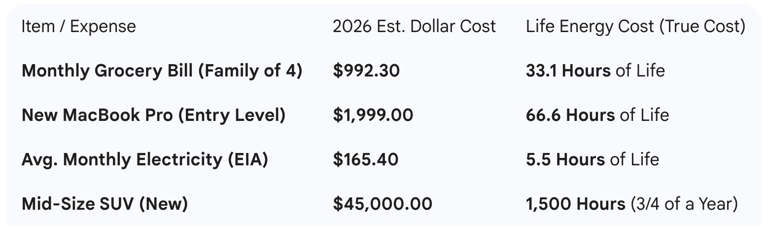
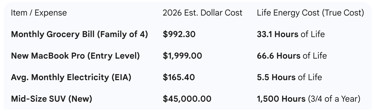
Table: 2026 "Life Energy" Audit (Sample Baselines)
Assumes a "Real Hourly Wage" (take-home pay after taxes) of $30.00/hour.
3. Privacy-First Computation
A core pillar of our methodology is Data Sovereignty. Unlike traditional financial apps that scrape bank data, The Vera Math uses a "Local Logic" approach.
Note: All calculator inputs are processed in real-time within your browser. We do not store, aggregate, or sell your specific financial numbers. We provide the math; you keep the data.
4. Continuous Calibration
The economy isn't static, and neither is our math. We perform quarterly audits of our underlying variables to ensure that as 2026 progresses, your "Strategic Spending" targets remain realistic and achievable.
Join the Executive Summary
Data is only as good as the decisions it informs. Stop guessing at the "True Cost" of your lifestyle. Join our Substack to receive the Executive Summary– our periodic briefing on shifting 2026 economic benchmarks and advanced Life Ledger strategies designed to protect your household’s most finite resource: your time.
External links for more information on this topic:
Contact
Feedback, inquiries: hello@theveramath.com
© 2026 The Vera Math. All rights reserved.
Privacy Policy & Terms
Financial Disclaimer: The content on The Vera Math is for informational and educational purposes only and does not constitute professional financial, tax, or legal advice. I am a Household CFO sharing personal experience and math-based insights; please consult with a licensed professional before making significant financial decisions.