
The Closet ROI: A CFO’s Guide to Cost-Per-Wear Math
Stop viewing clothes as expenses. Learn the "Cost Per Wear" formula to calculate the true ROI of your wardrobe and eliminate financial leaks.
FINANCIAL WELLNESS (LIFESTYLE)
Nyeva
2/13/20262 min read


The Strategy: From "Shopping" to "Procurement"
In a corporate environment, equipment is never just "bought"; it is procured based on its expected service life and utility. Your wardrobe is no different. It is a collection of functional assets designed to facilitate your daily life.
The problem? Most of us calculate the "cost" of a garment at the cash register. A Household CFO knows that the sticker price is a vanity metric. The only number that matters is the Cost Per Wear (CPW).
1. The Formula for True Value
To find the real impact on your bottom line, we have to look at the total cost of ownership over the life of the item.


Purchase Price: The upfront capital outlay.
Lifetime Maintenance: Tailoring, dry cleaning, or specialized storage.
Total Estimated Wears: The realistic number of times the item will be used before it fails or is retired.
2. The High-Cost Fallacy: Staples vs. Trends
We often feel "guilty" about a $200 pair of high-quality boots but feel "thrifty" buying a $30 trendy top. Let's look at the 12-month math:
The Investment Boot: $200 price + $0 maintenance. Worn 4 times a week for 6 months (96 wears). CPW = $2.08.
The Trend Top: $30 price. Worn 3 times before it loses shape in the wash. CPW = $10.00.
The Verdict: The "expensive" boot is nearly 5x cheaper than the "cheap" top. When you audit your closet through this lens, you realize that "saving money" on low-quality goods is actually a high-interest tax on your future self.
3. Performing the Wardrobe Audit (The 80/20 Rule)
Most households follow the 80/20 Pareto Principle: we wear 20% of our clothes 80% of the time. The other 80% represents "Stagnant Capital"– money sitting on a hanger providing zero utility.
The 3-Step Audit:
Identify the "Dead Assets": Anything not worn in the last 6 months.
Calculate the Leak: Total the original cost of those items. This is your "Capital Loss."
Optimize Future Procurement: Move that "lost" budget toward high-utility, low-CPW items.
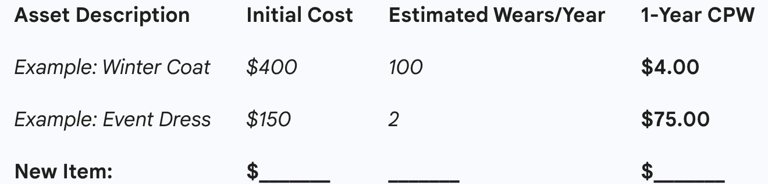
Executive Summary: The CPW Worksheet
Use this table before your next purchase to determine if the asset meets your "Real Life" benchmarks.
Leading Your Life with Data
Your wardrobe should work for you, not drain you. By shifting your mindset from spending to asset allocation, you ensure that every dollar in your closet is providing a return on your investment– whether that's in comfort, professional presence, or pure longevity.
Real math makes for a better life.
Audit Your Life, Not Just Your Ledger
Most financial leaks happen in the blind spots of our daily habits. If you’re ready to stop guessing and start measuring, join the Executive Summary via Substack. Our subscribers receive exclusive mathematical frameworks– including the Asset Longevity Worksheet– delivered directly to their inbox. Lead your household with data-backed confidence.
Contact
Feedback, inquiries: hello@theveramath.com
© 2026 The Vera Math. All rights reserved.


Privacy Policy & Terms
Financial Disclaimer: The content on The Vera Math is for informational and educational purposes only and does not constitute professional financial, tax, or legal advice. I am a Household CFO sharing personal experience and math-based insights; please consult with a licensed professional before making significant financial decisions.